ALX — A Precision Prodrug Engine
“ALX is a precision prodrug engine that turns existing drugs into new assets by adding conditional activation.”
Don’t redesign a pharmacophore that already works.
Redesign how it reaches the patient.
What ALX Is
ALX is a modular chemistry system that attaches a programmable ALX module to existing small-molecule drugs. This creates new versions with modulated PK, ADME, exposure, tolerability, and release profiles — without altering the drug’s pharmacology.
ALX applies broadly across small-molecule drugs, independent of therapeutic area, whenever functional modulation of PK, ADME, exposure, or delivery can create new, differentiated drug versions.
How ALX Works
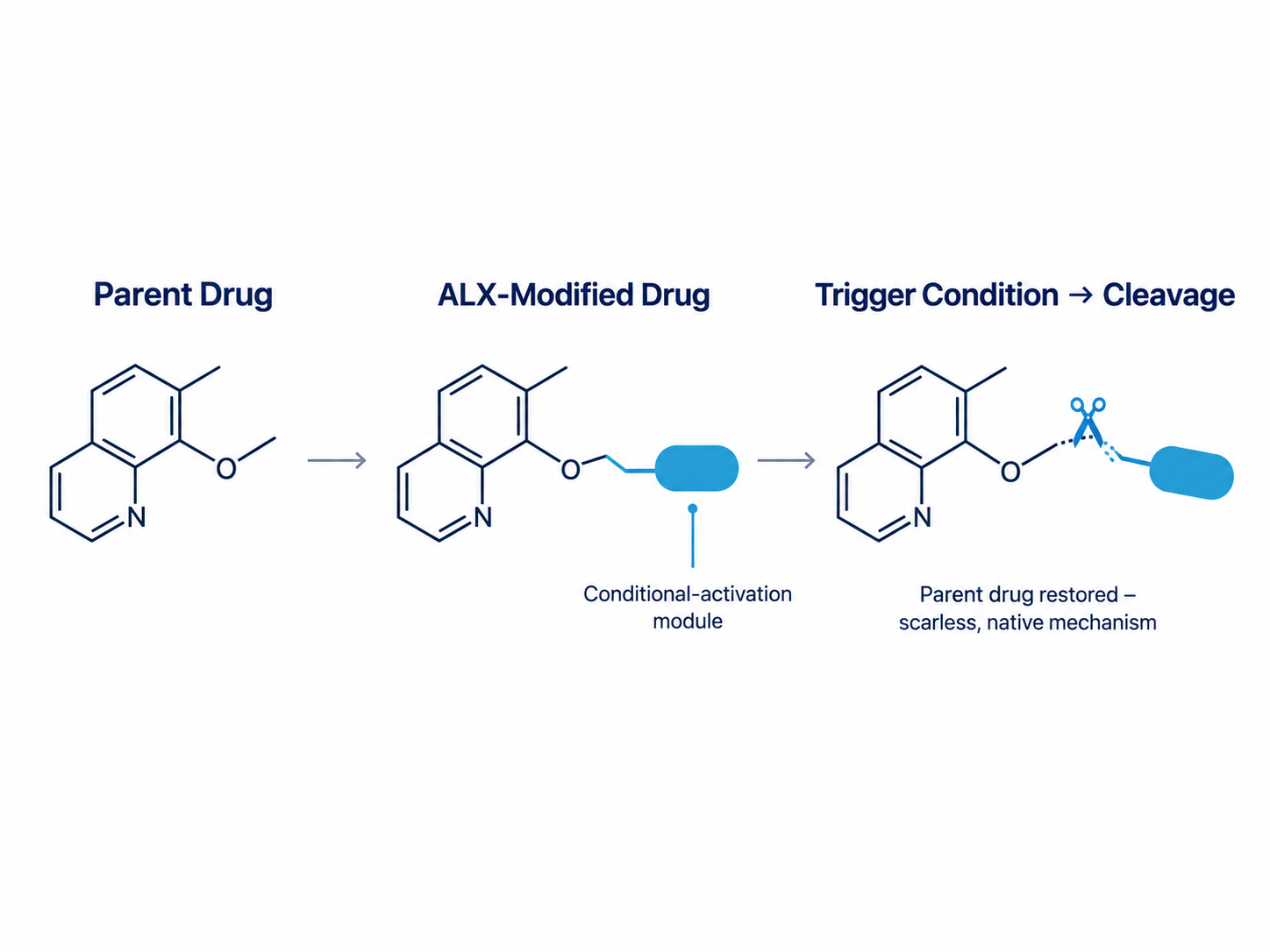
ALX attaches a conditional-activation module to an existing drug. The module modulates how the drug behaves in the body — not what the drug does. After cleavage under the trigger condition, the parent small-molecule drug is fully restored, scarless, and retains its native mechanism of action.
ALX Chemistry Restrictions
ALX uses biologically triggered small-molecule linkers only. To maintain ALX’s precision-prodrug architecture, the following restrictions apply:
Representative Linker Classes
- Small‑molecule linker systems
- Biologically responsive triggers
- Reversible activation chemistries
- Detailed chemistry and selection criteria remain confidential.
Not Allowed
- Peptides (beyond 1–3 aa triggers)
- Proteins
- Polymers
- ADC linkers
- Biological macromolecules
X-Domains
- Allowed: small-molecule only
- Not allowed: peptides, proteins, polymers, ADC linkers, biological macromolecules
These design principles maintain ALX as a small-molecule platform and may support 505(b)(2) development pathways where appropriate for a specific ALX candidate.
How ALX Modulates Drug Profiles
- PK stability
- Clearance tuning
- Exposure modulation
- Absorption improvement
- Dose-frequency reduction
- Tolerability window improvement
- Site-specific release
- Successor drug differentiation
- Post-LOE lifecycle extension
505(b)(2) Regulatory Pathway
Since ALX is a precision prodrug engine, ALX-enabled drugs may qualify for the FDA’s 505(b)(2) pathway, allowing new versions of existing drugs to leverage prior safety and efficacy data. This pathway can reduce development time, lower cost, and accelerate partner timelines for ALX-enabled successor drugs.
Why ALX Matters
ALX creates new, differentiated versions of existing small-molecule drugs. Partners use ALX to protect franchises, accelerate successor drugs, strengthen pipeline assets, and restore competitive advantage after LOE. ALX enables functional modulation without changing pharmacology, unlocking new commercial and regulatory pathways.
Drug Selection Criteria
This helps partners understand why certain drugs appear in the ALX Exemplars list.
- ✓Clean conjugation handles
- ✓CRO-available bioassays
- ✓Synthetic tractability
- ✓Coverage under ALX structure rules
- ✓Strong PK/ADME modulation opportunities
- ✓Clear successor-drug commercial relevance
What Makes ALX Different
- ✓Modular, programmable architecture
- ✓Conditional activation
- ✓Broad small-molecule applicability
- ✓Chemistry-confidential exemplars
- ✓Manufacturing licensing system
- ✓Portfolio-wide scalability
The Five ALX Pillars
ALX — A Precision Prodrug Engine
The modular ALX architecture enabling conditional activation and functional modulation of existing small-molecule drugs.
ALX Commercial Universe
All small-molecule drugs that can be upgraded, protected, or extended using ALX across multiple therapeutic areas.
ALX Pre-Licensing Universe
Early-access ALX rights that allow partners to secure franchise control, successor drug protection, and competitive lockout before LOE.
ALX Intelligence Platform
A continuously expanding map of drug-class vulnerabilities, franchise pressures, pipeline gaps, and successor drug opportunities.
ALX Manufacturing Licensing System
The controlled manufacturing rights required for CDMOs and API manufacturers to synthesize ALX-enabled compounds, including SKU governance and confidentiality enforcement.
Why ALX Matters Now
ALX enables successor drug creation before LOE closes. Partners use ALX to protect franchises, accelerate 505(b)(2) programs, and restore competitive advantage in crowded small-molecule classes.
Who ALX Is For
- Marketed drug franchises approaching LOE
- Pipeline assets needing differentiation
- Successor drug programs
- Portfolio teams seeking multi-program upgrades
- Companies facing competitive pressure in small-molecule classes
Controlled Visibility
CRAFT publicly shares ALX’s platform architecture and commercial logic, while all ALX chemistry, structural exemplars, linker families, and BD intelligence remain confidential and are disclosed only under controlled licensing agreements.
ALX Exemplars
ALX exemplars demonstrate how ALX can be applied across drug classes without disclosing chemistry. They show platform breadth, successor drug relevance, and competitive urgency across major therapeutic franchises.